CP 575 Course Day 24 Post
Day 24 Blog Post
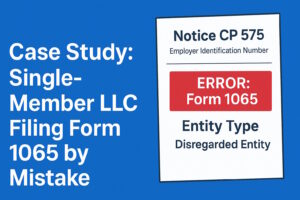
Case Study: A Single-Member LLC Mistakenly Filing Form 1065
Correct tax filing for LLCs depends heavily on understanding IRS rules, default classifications, and the information shown on Notice CP 575. Today’s post explores a real-world scenario where a single-member LLC (SMLLC) mistakenly files Form 1065 instead of its correct tax form. This case study demonstrates how such errors occur and how to fix them while staying compliant with the IRS.
Introduction
Single-member LLCs are automatically classified by the IRS as disregarded entities unless they have elected to be taxed as a corporation. This means the business income is normally reported on the owner’s individual tax return using Form 1040 Schedule C. However, many SMLLC owners mistakenly file Form 1065, believing that an LLC must file a partnership return simply because the entity type is “LLC” at the state level.
How the Mistake Happens
-
The confusion usually begins with one of the following:
-
The owner assumes all LLCs file partnership returns regardless of the number of members.
-
The business owner hires a tax preparer unfamiliar with US LLC tax classification rules.
-
The LLC has “LLC” in its title, which leads the owner to believe it must file a separate return.
-
The owner overlooks Notice CP 575, which clearly indicates how the LLC is classified by default unless an election is made.
Notice CP 575 holds crucial information, including:
-
Entity type assigned by IRS
-
Date the EIN was issued
-
Tax classification based on default rules
-
Whether the IRS expects a Schedule C, 1065, 1120, or 1120-S
When a single-member LLC files Form 1065, it contradicts the default IRS classification unless a formal election was made.
What Happens When a Single-Member LLC Files Form 1065 by Mistake
Here are the common consequences:
IRS Mismatch Notice
The IRS compares the business classification in their records with the tax form filed. When they notice the discrepancy, they issue a notice such as CP 2000 or CP 259E for missing or mismatched returns.
Potential Late Filing Penalties
If the IRS rejects the incorrect 1065 return, penalties may apply unless the owner corrects the mistake promptly.
Incorrect Tax Reporting
Partner capital accounts, K-1s, and partnership allocations do not apply to a single-member LLC, resulting in a structurally incorrect filing.
Impact on IRS Compliance History
Missing or mismatching returns can cause compliance flags that affect future elections such as S corporation status.
Correct Procedure to Fix the Mistake
The following steps correct the error and bring the business back into compliance:
Step 1: Review Notice CP 575
Confirm the entity type IRS has on file. For a single-member LLC, it will usually state “Sole Proprietor” or “Disregarded Entity.”
Step 2: File Correct Return (Form 1040 Schedule C)
Prepare and file the correct return for the relevant tax year. If deadlines have passed, file as soon as possible to reduce penalties.
Step 3: File an Amended Return (if necessary)
If a partnership return was wrongly filed, the business may need to file Form 1040-X with the corrected Schedule C attached.
Step 4: Respond to IRS Notices
If the IRS has already issued a mismatch notice, respond by sending:
-
A copy of Notice CP 575
-
A letter explaining the business is a single-member LLC
-
Corrected tax filings
-
Any supporting documentation requested by the IRS
Step 5: Ensure Future Correct Filing
If the owner intends to change the LLC’s classification, file:
-
Form 8832 to elect C-corporation
-
Form 2553 to elect S-corporation
Lessons Learned from This Case Study
This mistake highlights three important lessons for LLC owners:
-
Always check Notice CP 575 before filing.
-
Avoid assuming all LLCs must file a partnership return.
-
Understand the default IRS classification rules for LLCs.
Once the business owner understands the information in Notice CP 575 and how it ties to the correct tax form, filing becomes much simpler and more compliant.
Conclusion
Day 24 Post FI
A single-member LLC mistakenly filing Form 1065 is a common but easily fixable issue. By understanding the default tax classification rules and reviewing Notice CP 575 before filing, LLC owners can avoid unnecessary penalties, IRS notices, and compliance problems. This case study reinforces the importance of verifying the IRS classification before choosing a tax form and ensures future filings are accurate and stress-free.
Previous Post CP 575 Course Day 23 Post
Next Post CP 575 Course Day 25 Post