CP 575 Course Day 23 Post
Day 23: Common Errors – Misfiling as the Wrong Entity Type
One of the biggest reasons small business owners receive IRS notices, penalties, and delays is because they unknowingly file the wrong tax return for their LLC. This usually happens when the tax form they file does not match the entity type listed on their IRS Notice CP 575 or the elections they previously made using Form 8832 or Form 2553. Today’s lesson focuses on the most common misfiling errors and how to avoid them.
Understanding the Risk of Misfiling
The IRS expects every LLC to file according to its entity classification on record. When the wrong return is filed, the IRS system automatically generates mismatch notices because the computer system cannot reconcile the submitted form with the taxpayer’s classification in the database.
For example, if an LLC is classified as a partnership but files Form 1120-S, the IRS will reject the return or issue CP notices asking for correction.
Common Misfiling Mistakes
-
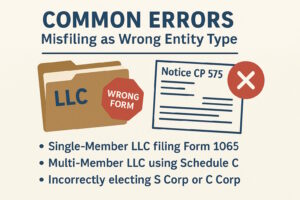
Single-Member LLC filing Form 1065
A single-member LLC without an election should file Schedule C (as part of Form 1040). Filing Form 1065 is incorrect unless the owner elected to be taxed as a partnership, which is extremely rare and not supported by IRS rules.
-
Multi-Member LLC filing Schedule C
A multi-member LLC is automatically considered a partnership unless an election is made. Filing Schedule C instead of Form 1065 is non-compliant and will trigger IRS corrections.
-
LLC electing S Corporation status but filing as a C Corporation
If Form 2553 is approved, the entity must file Form 1120-S. Filing Form 1120 instead will cause the IRS to revoke or question the S-Corp election.
-
LLC electing C Corporation status but filing as an S Corporation
Form 1120 must be filed after an approved Form 8832 election. Filing Form 1120-S without filing Form 2553 is invalid.
-
Ignoring the CP 575 classification entirely
Many new business owners never read their CP 575 notice and file based on assumptions or what an accountant tells them without verifying the IRS’s classification. CP 575 must always be used as the starting point.
-
Filing the wrong entity type after ownership changes
If an LLC goes from single-member to multi-member and the IRS is not notified, misfilings occur because classification rules automatically change with LLC structure.
-
Filing after deadlines, assuming elections were processed
If a business files Form 2553 or Form 8832 but assumes approval without receiving confirmation, it may file the wrong return. Filing retroactively without approval also causes mismatches.
Consequences of Filing the Wrong Tax Form
Misfiling can lead to serious administrative and financial consequences:
• IRS rejection of the tax return
• Delays in refund processing
• CP2000 or CP2501 notices for mismatches
• Penalties for failure to file the correct return
• Loss of S-Corp election if forms are not consistent
• Forced reclassification by the IRS
• Additional tax owed due to incorrect filing
How to Avoid These Errors
To stay compliant, always follow these steps:
Step 1: Review your CP 575 notice
Confirm the official IRS-recognized entity type.
Step 2: Check for approved elections
Verify if Form 8832 or Form 2553 was submitted and approved.
Step 3: Match the tax form to your classification
Ensure your return aligns with the IRS record.
Step 4: Update the IRS when ownership changes
Multi-member or single-member status changes must be addressed immediately.
Step 5: Keep annual compliance reminders
Most issues arise from assuming instead of verifying.
Conclusion
Day 23 Post FI
Misfiling as the wrong entity type is one of the most common IRS compliance mistakes for LLCs. By consistently reviewing your CP 575 notice and aligning your tax filing with your entity classification and elections, you can avoid costly penalties, delays, and misunderstandings. Tomorrow’s lesson will guide you through cross-checking CP 575 with IRS databases before filing.
Previous Post CP 575 Course Day 22 Post
Next Post CP 575 Course Day 24 Post