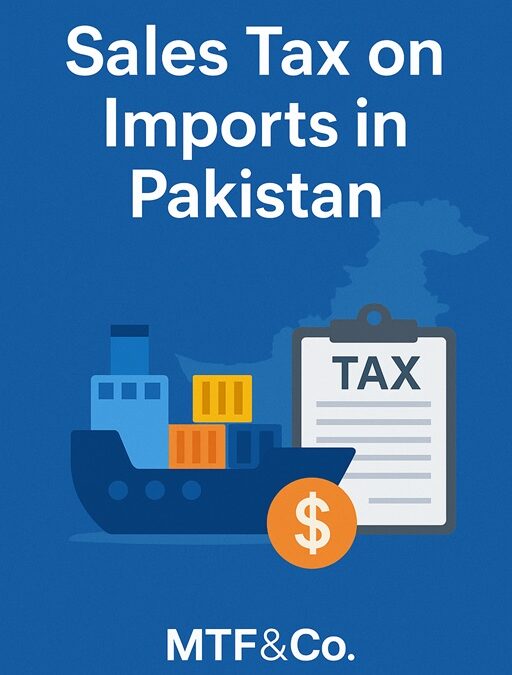
Sales Tax on Imports in Pakistan
Day 23: Sales Tax on Imports in Pakistan – Complete Guide
When goods are imported into Pakistan, sales tax becomes an important part of the customs clearance process. Importers are required to pay sales tax at the import stage, and this payment is integrated with customs duties and other applicable taxes. Understanding how sales tax on imports works, and how to claim it as input tax, is essential for businesses engaged in international trade.
In today’s blog, we’ll break down how sales tax is applied at customs, how import stage tax is adjusted, and what importers must keep in mind for compliance with the Federal Board of Revenue (FBR).
How Sales Tax is Applied at Customs
When goods are imported into Pakistan, the sales tax is charged at the time of customs clearance. This is assessed and collected by Pakistan Customs on behalf of the FBR.
- Standard Rate: Generally, the standard rate of 18% sales tax is applied on the value of imports.
- Value Calculation: The taxable value includes the CIF (Cost, Insurance, and Freight) value, customs duties, and other applicable levies.
- Zero-Rated Imports: Certain essential goods (e.g., raw materials, food items, and medicines) may fall under zero-rated or reduced sales tax rates.
- Exempted Imports: Goods specified under the Sixth Schedule of the Sales Tax Act, 1990 are exempt from sales tax at the import stage.
For instance, if machinery worth PKR 1,000,000 is imported and attracts 5% customs duty, the value for sales tax purposes will be:
CIF Value (1,000,000) + Customs Duty (50,000) = 1,050,000 x 18% = 189,000 (Sales Tax)
This sales tax is deposited at customs before goods are released.
Input Tax Adjustment of Import Stage Tax
One of the most important benefits for importers is that sales tax paid at the import stage is adjustable as input tax. This means it can be deducted against output tax (sales tax collected on supplies made locally).
- Claiming Input Tax: The amount of sales tax paid at customs is reflected automatically in the Annexures of STR-7 (sales tax return form).
- Requirement: Importers must ensure that goods are properly declared, and relevant invoices (Goods Declaration – GD) are available.
- Restrictions: Input tax cannot be claimed if imports relate to exempt supplies, personal use, or are covered under disallowed expenses (as per Section 8 of the Sales Tax Act).
- Carry Forward: If input tax exceeds output tax, the balance can be carried forward to subsequent months or claimed as a refund in some cases.
Compliance Considerations for Importers
To avoid penalties and ensure smooth tax credit claims, importers should keep the following in mind:
- Maintain Complete Documentation
- Goods Declaration (GD) form.
- Customs Duty and Sales Tax payment receipts.
- Import-related commercial invoices.
- Reconcile with STR-7
Ensure that import sales tax figures in the FBR system match the business’s internal records. Any mismatch may trigger FBR notices or audits. - Avoid Common Errors
- Incorrect HS code classification leading to wrong tax rates.
- Failing to declare imports correctly in monthly returns.
- Claiming input tax against ineligible imports.
Why It Matters for Businesses
Sales tax on imports can significantly increase landed costs. However, with proper compliance, it should not be treated as an extra expense because it is claimable as input tax. Businesses that maintain accurate import documentation can minimize risks, optimize cash flows, and avoid disputes with FBR.
Marketing Section – MTF & Co. Tax and Corporate Advisory
At MTF & Co. Tax and Corporate Advisory, we help importers and exporters manage their sales tax compliance efficiently. From import stage sales tax adjustment to input-output reconciliations, we ensure that your business is fully compliant with FBR requirements.
Through our platform One Web One Hub, we provide:
- Sales tax advisory and compliance services.
- Assistance with FBR audits and notices.
- Bookkeeping and documentation support for importers.
- Filing of monthly STR-7 returns with accurate input-output reconciliation.
If your business imports goods into Pakistan, let our experts guide you through tax-efficient strategies so that you can focus on growing your trade while we handle your compliance.
📞 Contact MTF & Co. today through One Web One Hub to simplify your sales tax and import compliance process!
Previous Post Common FBR Notices Related to Sales Tax
Next Post Sales Tax on Exports in Pakistan