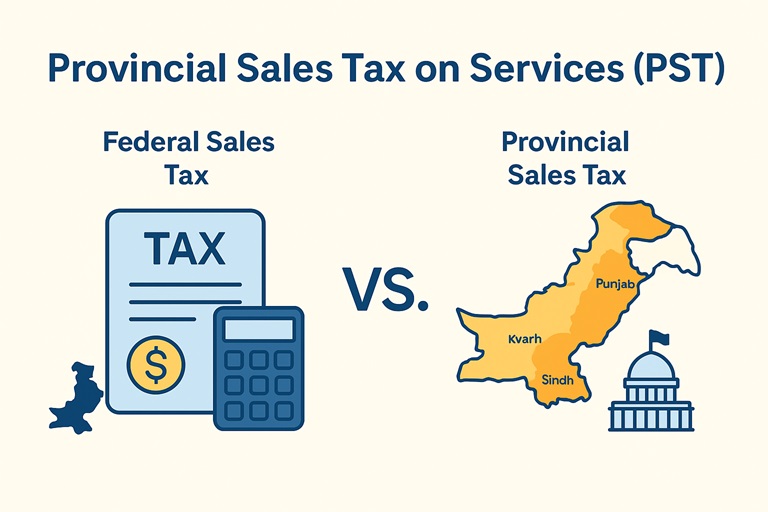
Provincial Sales Tax on Services in Pakistan
Day 4: Provincial Sales Tax on Services (PST) in Pakistan
When it comes to sales tax compliance in Pakistan, one of the areas that often creates confusion for businesses is Provincial Sales Tax on Services (PST). Unlike sales tax on goods, which is administered federally by the Federal Board of Revenue (FBR), sales tax on services is managed by provincial revenue authorities. Since the 18th Amendment to the Constitution of Pakistan in 2010, provinces have been given autonomy to legislate and collect sales tax on services.
In this detailed guide, we will explore:
- What is Provincial Sales Tax on Services?
- An overview of provincial tax authorities (PRA, SRB, KPRA, BRA).
- The difference between federal and provincial sales tax.
- Who needs to register for PST?
- The compliance process for provincial sales tax.
- Common challenges faced by businesses.
- Marketing section: How businesses can leverage compliance to build trust and credibility.
By the end of this article, you will have a clear understanding of how PST works and how to align your compliance strategy for smooth operations.
What is Provincial Sales Tax on Services?
Sales tax on services is a consumption tax levied on a wide range of services provided within a province. Unlike goods, which are taxed at the federal level under the Sales Tax Act 1990, services are taxed under separate provincial laws.
Each province has its own legislation, procedures, and tax authority. This means businesses operating in multiple provinces may need to comply with more than one set of rules.
Key point: Even if your business is registered with the FBR for sales tax on goods, you may still need a separate registration with a provincial authority if you provide taxable services.
Overview of Provincial Sales Tax Authorities
Here’s a breakdown of the four major provincial authorities that govern sales tax on services:
1. Punjab Revenue Authority (PRA)
The PRA was established in 2012 and regulates sales tax on services in Punjab. It covers a wide variety of services such as telecommunications, construction, restaurants, beauty parlors, courier services, and more.
The PRA has introduced online systems for registration, filing, and payment of PST, making compliance easier for businesses.
2. Sindh Revenue Board (SRB)
The SRB was the first provincial authority set up after the 18th Amendment in 2011. Sindh has been a leader in developing comprehensive regulations on sales tax for services.
SRB covers services such as franchise fees, security services, event management, and professional consultancy. Businesses operating in Karachi or across Sindh are required to register with SRB if they provide taxable services.
3. Khyber Pakhtunkhwa Revenue Authority (KPRA)
KPRA regulates services in Khyber Pakhtunkhwa and has been progressively updating its framework to align with global practices.
It covers services like hospitality, IT services, workshops, salons, and professional services. For businesses operating in KP, timely registration and filing with KPRA is crucial to avoid penalties.
4. Balochistan Revenue Authority (BRA)
BRA governs sales tax on services in Balochistan. Though relatively smaller in scale compared to SRB or PRA, BRA plays a vital role in ensuring fair taxation across the province.
BRA covers a similar list of services, including telecom, construction, hospitality, and other professional services.
Difference Between Federal and Provincial Sales Tax
Understanding the difference between federal and provincial tax authorities is essential for compliance.
- Federal Sales Tax (FBR):
- Applies to goods and products.
- Governed by the Sales Tax Act, 1990.
- Covers imports, manufacturing, and retail of goods.
- Registration is done through IRIS (FBR’s online portal).
- Provincial Sales Tax (PRA, SRB, KPRA, BRA):
- Applies to services provided within the province.
- Each province has its own law (e.g., Punjab Sales Tax on Services Act 2012).
- Separate registration is required in each province where services are provided.
- Filing and payment are done via provincial portals.
In short: Goods = FBR, Services = Provinces. Businesses offering both goods and services may need dual registration with FBR and relevant provincial authorities.
Who Needs to Register for Provincial Sales Tax?
Businesses that provide taxable services in a province must register with the relevant provincial revenue authority.
Examples of services requiring registration:
- Telecom and internet services.
- Hotels, restaurants, and caterers.
- Beauty salons and spas.
- Event management and advertising.
- Security services.
- Freight forwarding, courier, and logistics.
- Legal, medical, and consultancy services.
Even freelancers and consultants providing professional services across borders may fall under the scope of PST, depending on the province’s rules.
The Compliance Process for PST
The compliance process usually involves:
- Registration
- Apply online through the provincial authority’s website.
- Submit supporting documents (CNIC, NTN, incorporation documents, utility bills, etc.).
- Receive a Sales Tax Registration Number (STRN) specific to that province.
- Monthly Filing
- File PST returns every month (usually by the 15th or 18th of the following month).
- Declare the value of taxable services and calculate tax liability.
- Payment of Tax
- Payments can be made through designated banks or online channels.
- Withholding Agents
- In some cases, customers are designated as withholding agents. This means they deduct PST at source and deposit it on your behalf.
Common Challenges in PST Compliance
- Multiple Registrations: Businesses providing services across provinces must maintain separate registrations and returns.
- Variation in Laws: Each authority has slightly different rules and tax rates, creating complexity.
- Withholding Mechanisms: Many businesses struggle with reconciling withheld taxes and claiming adjustments.
- Penalties for Non-Compliance: Late filing, non-filing, or incorrect filing can attract heavy penalties and surcharges.
Marketing Section: Leveraging Compliance for Business Growth
While compliance may feel like a burden, businesses can actually use it to their advantage. Here’s how:
- Building Trust with Clients
Customers and corporate clients prefer to work with registered, tax-compliant businesses. Showing your PST compliance status boosts your credibility. - Gaining Access to Bigger Contracts
Many government and corporate contracts require tax-compliant vendors. Having valid PRA, SRB, or KPRA registration can make your business eligible for large projects. - Strengthening Your Brand Image
Marketing your compliance status on your website, invoices, and business profiles demonstrates professionalism and reliability. - Creating a Unique Selling Proposition (USP)
In industries where many competitors are unregistered or operating informally, being tax compliant sets you apart and allows you to justify premium pricing. - Content Marketing Strategy
Businesses can write blogs, publish guides, and share insights about compliance to establish themselves as thought leaders in their niche. For example, a consultancy firm can publish regular updates on PRA rules to attract potential clients.
Conclusion
Day 4 Post
Provincial Sales Tax on Services (PST) plays a crucial role in Pakistan’s taxation framework. With different provinces having their own rules and authorities, businesses must carefully assess where they need to register and how to stay compliant.
Instead of viewing compliance as a cost, businesses can use it as a marketing tool to build trust, credibility, and long-term growth. By staying compliant with PRA, SRB, KPRA, and BRA, businesses not only avoid penalties but also position themselves as reliable and professional in the eyes of clients.
Previous Post Sales Tax Registration in Pakistan via IRIS
Next Post Sales Tax Rates in Pakistan