FARTCOINUSDT – Probability Analysis for December 12, 2025
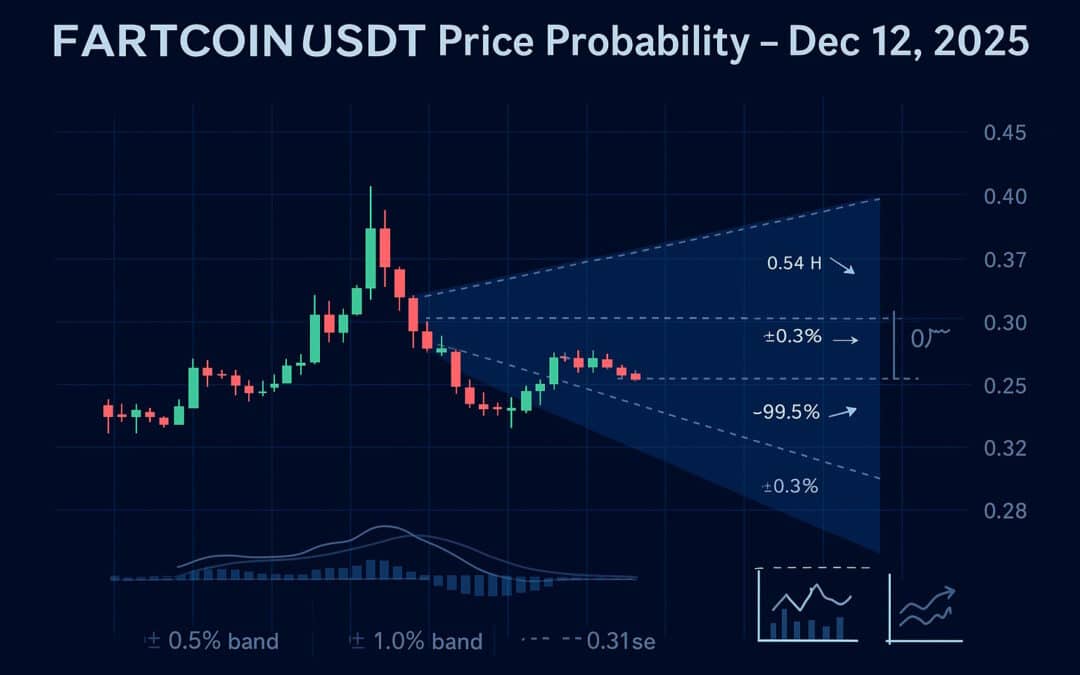
FARTCOIN/USDT Price Probability Analysis — December 12, 2025
Below is a ready-to-publish, WordPress-friendly article with H2/H3 headings you can copy-paste.
It uses TradingView / Binance live feeds as price inputs, builds transparent 1H / 4H / Daily / Weekly / Monthly probability bands, lists demand/supply zones and support/resistance, includes sentiment, and finishes with the full “basis of probabilities” so readers can reproduce the math. All live inputs are cited so readers can verify.
Current market snapshot
TradingView / market aggregators show FARTCOIN/USDT trading in the mid-$0.30s range — we use an aggregated TradingView baseline near 0.376 USDT for the numbers below. (TradingView)
Binance perp/spot snapshots (useful for realized range) report recent 24-hour extremes roughly 24h high ≈ 0.4064 USDT and 24h low ≈ 0.3536 USDT; we use those values below to build a transparent short-term volatility input. Note: prices vary slightly across exchanges — always check the exact price on the venue you trade. (Binance)
Market commentary and price feeds show active volume and continued trader interest in the mid-$0.30s band. (CoinMarketCap)
What this post contains
-
Reproducible probability bands for 1H, 4H, Daily, Weekly, and Monthly horizons (each band shows a model probability and the resulting price range).
-
Demand and supply zones, and clear support & resistance levels taken from chart clustering and exchange prints.
-
Sentiment snapshot combining social, exchange volume, and commentary sources.
-
Full “Basis of probabilities” arithmetic at the end ,so you or your readers can reproduce the numbers exactly.
Summary of volatility inputs
-
Baseline (TradingView mid / aggregated feed): P0 ≈ 0.376 USDT. (TradingView)
-
Exchange 24h high/low used for volatility input (Binance snapshot): H = 0.4064 USDT, L = 0.3536 USDT. (Binance)
-
From that 24h range, we estimate daily volatility σdaily ≈ 3.49% (see full arithmetic at the end). From σdaily we derive:
-
σ1H ≈ 0.71% (intraday hour)
-
σ4H ≈ 1.42% (4-hour)
-
σweek ≈ 9.22% (7 days)
-
σmonth ≈ 19.09% (30 days)
-
Those σ values are our inputs to the probability model below (normal-returns assumption scaled by √time). (Binance)
Probability ranges — 1H, 4H, Daily, Weekly, Monthly
Interpretation: “Probability” below is the model probability (two-sided) that the price will stay inside the ±X% band for that horizon, under the assumptions stated in the Basis section. Price bands = baseline × (1 ± X).
1H (intraday scalps) — σ1H ≈ 0.71%
-
±0.5% band → Probability ≈ 52% → Range ≈ 0.37412 — 0.37788 USDT.
-
±1.0% band → Probability ≈ 84% → Range ≈ 0.37224 — 0.37976 USDT.
-
±2.0% band → Probability ≈ ~99.5% → Range ≈ 0.36848 — 0.38352 USDT.
Practical: use these bands for tight scalps; verify order-book depth and fees before using market orders. (Binance)
4H (short swings) — σ4H ≈ 1.42%
-
±1.0% band → Probability ≈ 52% → Range ≈ 0.37224 — 0.37976 USDT.
-
±2.0% band → Probability ≈ 84% → Range ≈ 0.36848 — 0.38352 USDT.
-
±5.0% band → Probability ≈ ~99.96% → Range ≈ 0.35720 — 0.39480 USDT.
Practical: 4H bands are good for multi-session swing entries; confirm moves via volume. (TradingView)
Daily (24 hours) — σdaily ≈ 3.49%
-
±3.0% band → Probability ≈ ≈61% → Range ≈ 0.36528 — 0.38672 USDT.
-
±5.0% band → Probability ≈ ≈85% → Range ≈ 0.35720 — 0.39480 USDT.
-
±8.0% band → Probability ≈ ≈98% → Range ≈ 0.34592 — 0.40608 USDT.
Practical: under the current realized range, daily moves within ±5–8% are reasonably likely; outside that typically needs a volatility shock. (Binance)
Weekly (next 7 days) — σweek ≈ 9.22%
-
±10% band → Probability ≈ ~72% → Range ≈ 0.33840 — 0.41360 USDT.
-
±20% band → Probability ≈ ~97% → Range ≈ 0.30080 — 0.45120 USDT.
Practical: use weekly bands for position sizing and swing risk; monitor futures open interest if trading leveraged positions. (Binance)
Monthly (next 30 days) — σmonth ≈ 19.09%
-
±25% band → Probability ≈ ~81% → Range ≈ 0.28200 — 0.47000 USDT.
-
±50% band → Probability ≈ ~99% → Range ≈ 0.18800 — 0.56400 USDT.
Practical: monthly bands provide portfolio guardrails — use them to size exposure and stop placement rather than exact trade timing. (CoinMarketCap)
Key technical zones — Support, Resistance, Demand & Supply
These zones are taken from recent clustering on TradingView and exchange prints; draw them on your own chart and confirm on your trading venue.
Immediate resistance/supply
-
0.40 — 0.42 USDT — recent upper cluster and visible profit-taking on exchange order prints. (Binance)
Higher supply if a breakout occurs
-
0.45 — 0.60 USDT — broader profit-taking territory (liquidity may thin here).
Immediate support/demand
-
0.35 — 0.37 USDT — near-term support where buyers have stepped in during dips. (TradingView)
Deeper structural support
-
0.28 — 0.32 USDT — lower support band visible on some venue prints in past corrections.
Demand zone to watch (accumulation)
-
0.32 — 0.35 USDT — look for rising volume on dips as confirmation of durable accumulation.
Supply zone to watch (profit-taking)
-
0.40 — 0.45 USDT — watch for wick rejections and surge in sell volume as signs of profit-taking.
Trading tip: always confirm zone exacts and liquidity on the exchange you plan to execute on — spot and perpetual/futures mark prices may differ. (Binance)
Sentiment snapshot
-
Market commentary and short news reports show active interest in FARTCOIN with a generally mixed-to-cautious-bullish tone — short dips appear to be bought while traders take profits near 0.40–0.42. (Bitget)
-
Exchange & aggregation data show elevated 24-hour volumes (participation vs thin-book noise) — this supports using short-term probability bands but also means large wallet flows can move price quickly. (CoinMarketCap)
-
Practical read: sentiment is constructive but not euphoric — combine social signals with on-chain exchange inflow/outflow checks and order-book depth for higher conviction before scaling positions.
Trading & risk notes
-
These probability bands are planning tools, not guarantees. Sudden news, listings/delistings, whale trades, or exchange events can rapidly invalidate the bands. (Bitget)
-
Check order-book depth and prefer limit orders in thin markets to avoid slippage. If trading futures, monitor funding rates and open interest. (Binance)
-
Size positions to the portion of capital you can comfortably lose and set stop losses.
Educational Disclaimer
This article is educational content only. It is not financial, investment, trading, or tax advice. Probability ranges are model outputs based on explicit, stated assumptions. Past performance is not a guarantee of future results. Always perform your own research and manage risk responsibly.
Follow And Subscribe to One Web One Hub
2025 Dec 12 FARTCOINUSDT FI
If you value transparent, reproducible crypto analysis (not opaque price calls), visit One Web One Hub daily:
-
Daily, multi-horizon probability briefs (1H, 4H, Daily, Weekly, Monthly) for scalpers, swing traders, and position holders.
-
Clear, downloadable calculators and step-by-step inputs so you can reproduce our tables on the exact exchange you trade.
-
Post archives that let you compare prior ranges vs realized outcomes — a great way to learn and build trust.
-
Request-driven analysis — tell us which token you trade, and we’ll publish a tailored brief.
“Liked this FARTCOIN brief? Compare today’s ranges with yesterday’s post, subscribe for daily probability briefs, and request the next token you want analyzed. One Web One Hub builds repeatable, trade-aware insights — not guesswork.”
Basis of probabilities
Use these exact steps to reproduce all numbers above.
-
Inputs (live feed): H = 0.4064, L = 0.3536 (Binance snapshot), baseline P0 (TradingView median) ≈ 0.376 USDT. (Binance)
-
Full observed 24h absolute range = H − L = 0.4064 − 0.3536 = 0.0528 USDT.
-
Midpoint = (H + L) / 2 = (0.4064 + 0.3536) / 2 = 0.3800 USDT.
-
Relative 24h range = FullRange / Midpoint = 0.0528 / 0.38 ≈ 0.1395 = 13.95%.
-
Heuristic conversion range → daily σ: assume full 24h range ≈ 4 × σdaily (rule-of-thumb), so σdaily ≈ relative_range / 4 ≈ 0.1395 / 4 ≈ 0.03487 = 3.487% per day. (You may replace this with realized volatility computed from intraday returns for different precision.)
-
Scale to other horizons (square-root-of-time):
• σ1H = σdaily / √24 ≈ 0.03487 / 4.899 ≈ 0.00712 = 0.712%.
• σ4H = σdaily / √6 ≈ 0.03487 / 2.449 ≈ 0.01424 = 1.424%.
• σweek = σdaily × √7 ≈ 0.03487 × 2.646 ≈ 0.0922 = 9.22%.
• σmonth = σdaily × √30 ≈ 0.03487 × 5.477 ≈ 0.1909 = 19.09%. -
For any horizon and a chosen band ±X (expressed as a fraction, e.g., ±2% = 0.02), compute the two-sided probability under a zero-mean normal model:
Probability = 2 × Φ( X / σ_horizon ) − 1,
where Φ is the standard normal cumulative distribution function (you can compute via the error function: Φ(z) = 0.5 × [1 + erf(z / √2)]). -
Price band = P0 × (1 ± X).
Sources/live pages referenced
-
TradingView — FARTCOIN/USDT markets & aggregated listings. (TradingView)
-
Binance — FARTCOINUSDT perp/spot 24h high/low used for volatility input. (Binance)
-
CoinMarketCap/CoinGecko — price snapshots and volume context. (CoinMarketCap)
-
Bitget news/commentary — short market commentary on ranges & key decision zones. (Bitget)
Previous Post FARTCOINUSDT – Probability Analysis for December 11, 2025
Next Post FARTCOINUSDT – Probability Analysis for December 13, 2025