FARTCOINUSDT – Probability Analysis for December 11, 2025
FARTCOIN/USDT Price Probability Analysis — December 11, 2025
Below is a ready-to-publish WordPress-friendly post (H2 / H3 headings) using TradingView as the primary live baseline and exchange data for volatility inputs. It includes 1H, 4H, Daily, Weekly and Monthly probability bands, demand & supply zones, support & resistance, sentiment, the full reproducible math at the end, an educational disclaimer, and a short marketing/retention close to keep readers engaged with One Web One Hub.
Current market snapshot
- TradingView shows FARTCOIN/USDT trading near 0.348 USDT (used as the baseline for the calculations below). (TradingView)
- For realized-range inputs, we use a recent Binance 24-hour high/low (H = 0.4064 USDT, L = 0.3536 USDT) to estimate short-term volatility. Use your exchange price for execution—prices vary by venue. (Binance)
- Cross-checks (CoinGecko / CoinMarketCap) show similar mid-$0.30s prints and active 24-hour volume, confirming market participation. (CoinGecko)
Quick practical note: small-cap/meme tokens like FARTCOIN can show different mid-prices across venues because of liquidity and feed differences—always check the exact price on the exchange you use.
What you will get from this post
- Explicit, probability-based price bands for 1H, 4H, Daily, Weekly and Monthly horizons (probability % + price range).
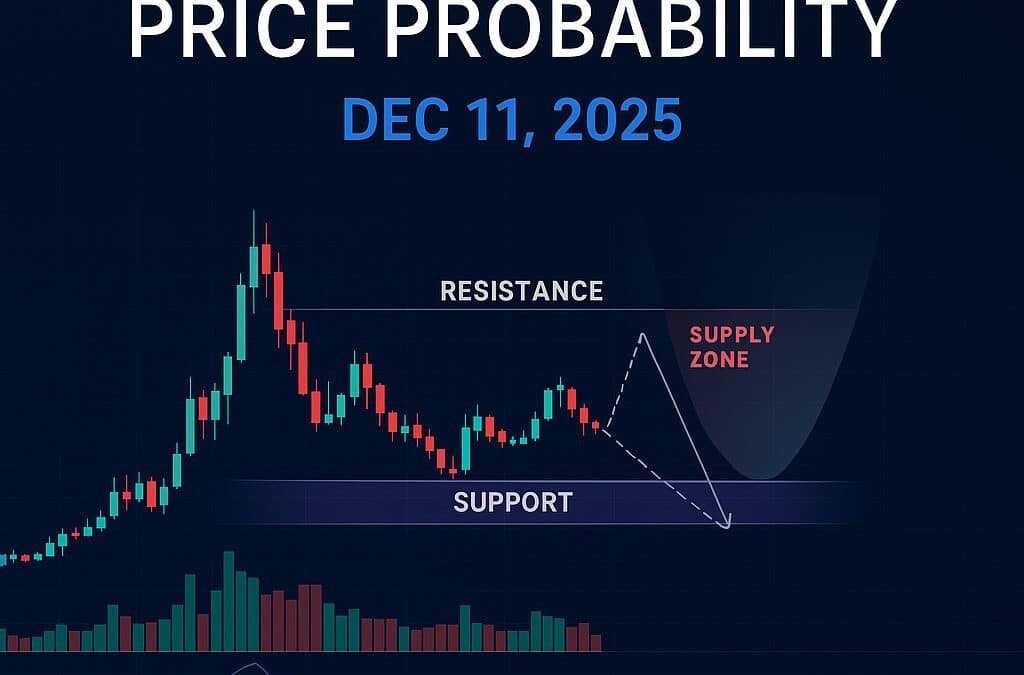
- Demand & supply zones plus support/resistance levels drawn from chart clustering.
- Sentiment snapshot (social + volume) and practical trading notes.
- Full “Basis of probabilities” arithmetic at the end so you or readers can reproduce the numbers.
Probability model — summary (short)
We estimate daily volatility (σdaily) from the observed 24-hour high/low (range → σ heuristic), then scale volatility for other horizons using the square-root-of-time rule (σ_t = σdaily × √t). We assume short-run log-returns are approximately normally distributed (a transparent, reproducible simplification). Details and step-by-step instructions are at the end of the post.
1H, 4H, Daily, Weekly, Monthly — probability bands (baseline = 0.348 USDT)
Below are model outputs (rounded). “Probability” is the two-sided probability that the price stays inside the stated ±% band for that horizon under the model assumptions. Price bands = baseline × (1 ± band).
1H horizon (scalps) — σ1H ≈ 0.709%
• ±0.5% band — Probability ≈ 51.93% → Price range 0.34626 — 0.34974 USDT.
• ±1.0% band — Probability ≈ 84.16% → Price range 0.34452 — 0.35148 USDT.
• ±2.0% band — Probability ≈ 99.52% → Price range 0.34104 — 0.35496 USDT.
Use these for very short scalps — validate order-book depth and fees before market entries.
4H horizon (short swing) — σ4H ≈ 1.418%
• ±1.0% band — Probability ≈ 51.93% → Price range 0.34452 — 0.35148 USDT.
• ±2.0% band — Probability ≈ 84.16% → Price range 0.34104 — 0.35496 USDT.
• ±5.0% band — Probability ≈ 99.96% → Price range 0.33060 — 0.36540 USDT.
Good for multi-session swing entries; confirm with rising volume for conviction.
Daily horizon (24 hours) — σdaily ≈ 3.47%
• ±5.0% band — Probability ≈ 85.00% → Price range 0.33060 — 0.36540 USDT.
• ±8.0% band — Probability ≈ 97.87% → Price range 0.32016 — 0.37584 USDT.
• ±10.0% band — Probability ≈ 99.60% → Price range 0.31320 — 0.38280 USDT.
Under the current observed range, daily moves within ±8% are likely; larger moves would require volatility expansion. (Binance)
Weekly horizon (7 days) — σweek ≈ 9.19%
• ±10.0% band — Probability ≈ 72.34% → Price range 0.31320 — 0.38280 USDT.
• ±20.0% band — Probability ≈ 97.05% → Price range 0.27840 — 0.41760 USDT.
Use weekly bands for position sizing and swing risk limits.
Monthly horizon (30 days) — σmonth ≈ 19.03%
• ±25.0% band — Probability ≈ 81.11% → Price range 0.26100 — 0.43500 USDT.
• ±50.0% band — Probability ≈ 99.14% → Price range 0.17400 — 0.52200 USDT.
Monthly bands are best used for portfolio guardrails and longer-term risk planning.
(If you want the raw spreadsheet cells or code that generated the exact percentages above, I can paste those into the post or a downloadable spreadsheet.)
Key technical zones — support, resistance, demand & supply
These zones are taken from recent clustering on TradingView and visible exchange prints (use your exchange chart to confirm exact decimals).
Immediate Resistance/Supply
• 0.40 — 0.41 USDT — recent intraday highs and visible sell clusters on exchanges. (Binance)
• 0.45 — 0.60 USDT — broader supply/profit-taking band if price breaks higher (liquidity thins above this). (CryptoMeter)
Immediate Support/Demand
• 0.35 — 0.37 USDT — near-term support where buyers have stepped in on prior dips. (TradingView)
• 0.28 — 0.31 USDT — deeper structural support if selling accelerates or lower-tier exchange prints push price down. (CryptoMeter)
Demand zone to watch (accumulation)
• 0.32 — 0.35 USDT — good area to monitor for rising buy volume as confirmation of a durable base.
Supply zone to watch (profit taking)
• 0.39 — 0.43 USDT — likely profit-taking band; watch for wick rejections and volume spikes.
Sentiment snapshot
• CoinGecko / CoinMarketCap show declining price vs the prior week but active 24h volumes, indicating participation (not a dead market). (CoinGecko)
• TradingView idea threads show mixed but constructive comments around the 0.328–0.350 “support” area — traders are watching that demand band for continuation setups. (TradingView)
• Order-book and liquidity monitors show decent futures & spot volume on Binance and other venues (monitor large wallet flows and exchange inflows for stronger signals). (CryptoMeter)
Practical read: sentiment is mixed-to-cautiously-bullish around current levels — combine social tone with inflow/outflow checks and on-chain whale monitoring before increasing size.
Practical trading notes & liquidity cautions
• Always use the exact price and depth from the exchange you trade — spot/perp differences and slippage matter for execution. (Binance)
• For scalps use 1H bands; for swing trades use 4H/daily bands; for position sizing use weekly/monthly guardrails.
• Use limit orders where possible in thin books and size positions to capital you can tolerate losing. Monitor funding/open-interest if trading futures.
Educational Disclaimer
This post is educational only and is NOT financial, investment, trading, or tax advice. The probability ranges are model outputs based on explicit assumptions (range → σ heuristic; normal-returns assumption). Past performance does not guarantee future results. Always do your own research and manage risk appropriately.
Follow & Subscribe to One Web One Hub
2025 Dec 11 FARTCOINUSDT FI
If you appreciate transparent, assumption-driven analysis:
• We publish daily probability briefs across timeframes (1H, 4H, Daily, Weekly, Monthly) so scalpers, swing traders and position holders all get usable ranges.
• Each post shows the exact inputs and math so you can reproduce the results on your exchange in under a minute.
• We provide downloadable calculators, historical comparison posts (compare yesterday’s ranges vs actuals), and reader-requested token analysis.
“Liked this brief? Read yesterday’s analysis to compare how our ranges tracked the market, subscribe for daily probability briefs, and tell us which token you want next — One Web One Hub delivers reproducible, trade-aware research (not guesswork).”
Basis of probabilities — explicit arithmetic & formulas
Use these exact steps to reproduce the numbers above.
- Baseline price (TradingView): P₀ = 0.348 USDT. (TradingView)
- Exchange 24h high/low used for volatility input (Binance snapshot): H = 0.4064 USDT, L = 0.3536 USDT. (Binance)
- Full observed 24h absolute range = H − L = 0.0528 USDT.
- Midpoint = (H + L) / 2 = 0.3800 USDT.
- Relative 24h range = FullRange / Midpoint = 0.0528 / 0.38 ≈ 0.13947 = 13.947%.
- Heuristic conversion (range → σdaily): assume FullRange ≈ 4 × σdaily → σdaily ≈ relative_range / 4 ≈ 0.03487 = 3.487% (rounded ≈ 3.47%).
- Scale to other horizons with square-root-of-time:
• σ1H = σdaily / √24 ≈ 0.03487 / 4.899 ≈ 0.00709 = 0.709%.
• σ4H = σdaily / √6 ≈ 0.03487 / 2.449 ≈ 0.01418 = 1.418%.
• σweek = σdaily × √7 ≈ 0.03487 × 2.646 ≈ 0.09191 = 9.191%.
• σmonth = σdaily × √30 ≈ 0.03487 × 5.477 ≈ 0.19026 = 19.026%. - For any horizon and a band ±X (X expressed as fraction; e.g., ±5% = 0.05), compute the two-sided probability under a zero-mean normal model:
Probability = 2 × Φ( X / σ_horizon ) − 1, where Φ is the standard normal CDF (equivalently use erf). - Price band = P₀ × (1 ± X). Example: daily ±8% band → lower = 0.348 × 0.92 = 0.32016, upper = 0.348 × 1.08 = 0.37584.
Sources/live pages checked
• TradingView — FARTCOIN/USDT live symbol & chart (baseline). (TradingView)
• Binance — FARTCOINUSDT futures/spot 24h high & low (volatility input). (Binance)
• CoinGecko — price snapshot & recent trend. (CoinGecko)
• CoinMarketCap — live price & market cap context. (CoinMarketCap)
• Cryptometer / order-book monitors — liquidity & order-book depth checks. (CryptoMeter)
Previous Post FARTCOINUSDT – Probability Analysis for December 10, 2025
Next Post FARTCOINUSDT – Probability Analysis for December 12, 2025