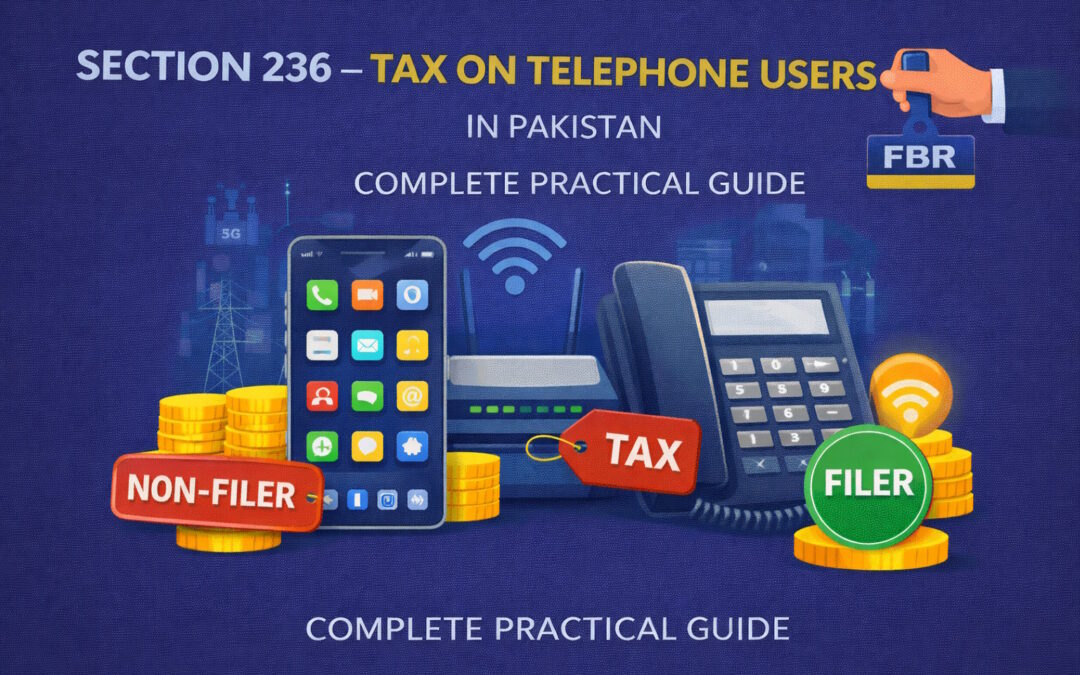
Pakistan Practical Taxation Course Post 16
Post 16 – Section 236: Advance Tax on Telephone Users in Pakistan
Introduction to Section 236
Section 236 of the Income Tax Ordinance, 2001 deals with advance tax collected from telephone users in Pakistan. This tax is collected at the time of paying telephone, mobile, and internet bills. It applies to both prepaid and postpaid users and is one of the most common forms of indirect advance tax faced by individuals and businesses.
The objective of Section 236 is to bring undocumented income earners into the tax net and encourage individuals to file income tax returns.
What is Section 236 Tax?
Section 236 imposes an advance income tax on the use of telecommunication services. This tax is collected by telecom operators and deposited with the Federal Board of Revenue (FBR) on behalf of the consumer.
It is adjustable for filers and treated as minimum or final tax for non-filers, depending on circumstances.
Who Collects the Tax?
The tax under Section 236 is collected by:
- Cellular mobile operators
- Landline telephone companies
- Internet service providers (ISPs)
These service providers act as withholding agents under the law.
Applicable Services Under Section 236
Section 236 applies to:
- Mobile phone calls
- SMS services
- Mobile data / internet usage
- Landline telephone usage
- Broadband and internet services
Both prepaid and postpaid users are covered.
Tax Rates Under Section 236
The tax rate under Section 236 depends on whether the user is a filer or non-filer.
For Filers
- Lower rate of advance tax is applied
- Tax is adjustable against annual income tax liability
- Can be claimed in the income tax return
For Non-Filers
- Higher rate is charged
- Tax is treated as minimum tax
- Cannot be easily adjusted or refunded
The government frequently revises rates through Finance Acts, so users should always check the latest FBR notifications.
Prepaid vs Postpaid Users
Prepaid Users
- Tax is deducted at the time of recharge or balance load
- Deduction is immediate and automatic
Postpaid Users
- Tax is charged in the monthly bill
- Appears as a separate line item
Is Section 236 Tax Adjustable?
Yes, but only for filers.
For Filers
Adjustable against final tax liability
Refund can be claimed if excess tax is paid
For Non-Filers
Generally treated as minimum tax
Refund claims are not entertained unless filer status is restored
This makes NTN registration and return filing extremely important.
How to Claim Section 236 Tax Credit
To claim tax deducted under Section 236:
- Ensure your NTN is active
- File annual income tax return
- Check withholding tax details in IRIS
- Declare the tax under adjustable taxes
- Submit return and computation
Telecom companies upload withholding details directly to FBR, making verification easier.
Impact of Section 236 on Common Users
Salaried Individuals
- Tax is adjustable
- Often leads to refunds if salary tax already deducted
Freelancers
- Adjustable against income tax
- Important for cash-flow planning
Business Owners
- Counts as advance tax
- Helps reduce final tax payable
Students and Low-Income Users
Often end up paying non-refundable tax if not registered
This highlights how indirect taxes disproportionately affect non-filers.
How to Avoid Higher Tax Under Section 236
- Register for NTN
- File income tax return annually
- Maintain filer status
- Regularly check Active Taxpayers List (ATL)
Being an active filer significantly reduces telecom tax burden.
Common Misconceptions About Section 236
- This tax is separate from sales tax
- It is not a telecom service charge
- It is an income tax, not a fee
- Refund is possible only for filers
Understanding these points helps avoid confusion while reviewing phone bills.
Conclusion
Section 236 tax on telephone users is a small but recurring tax that impacts almost every individual and business in Pakistan. While it may seem insignificant per transaction, it accumulates over the year. Becoming an active filer allows taxpayers to adjust or reclaim this tax and avoid unnecessary financial loss.
For compliance, savings, and better tax planning, registering with FBR and filing returns is no longer optional—it is essential.
Disclaimer
Pakistan Practical Taxation Course Post 16 FI
This article is for educational and informational purposes only and does not constitute legal or tax advice. Tax laws are subject to change through Finance Acts and FBR notifications. Readers are advised to consult a qualified tax professional before making tax decisions.
Previous Post Pakistan Practical Taxation Course Post 15
Next Post Pakistan Practical Taxation Course Post 17