Pakistan Practical Taxation Course Post 10
Section 147 – Advance Income Tax in Pakistan Explained with Practical Examples
Introduction
Section 147 of the Income Tax Ordinance, 2001 deals with advance income tax, which is payable during the tax year instead of waiting until the annual return is filed. This section mainly applies to business individuals, AOPs, and companies earning taxable income other than salary.
Advance tax plays a crucial role in Pakistan’s tax system as it ensures timely revenue collection for FBR and reduces the year-end tax burden on taxpayers.
What is Advance Income Tax under Section 147?
Advance income tax is the estimated tax liability that a taxpayer is required to pay in installments during the tax year based on expected income.
The tax is paid before the end of the tax year and later adjusted against final tax liability while filing the annual income tax return.
Who is Required to Pay Advance Tax under Section 147?
Advance tax under Section 147 is applicable to:
• Companies
• Associations of Persons (AOPs) (Registered Firms)
• Business Individuals
• Professionals earning taxable business income
Salaried individuals are generally not covered, unless they have additional taxable income.
Basis of Advance Tax Calculation
Advance tax is calculated based on:
• Last assessed income
• Turnover or expected income
• Previous year’s tax liability
FBR may issue an advance tax demand based on prior returns.
Payment Schedule of Advance Tax
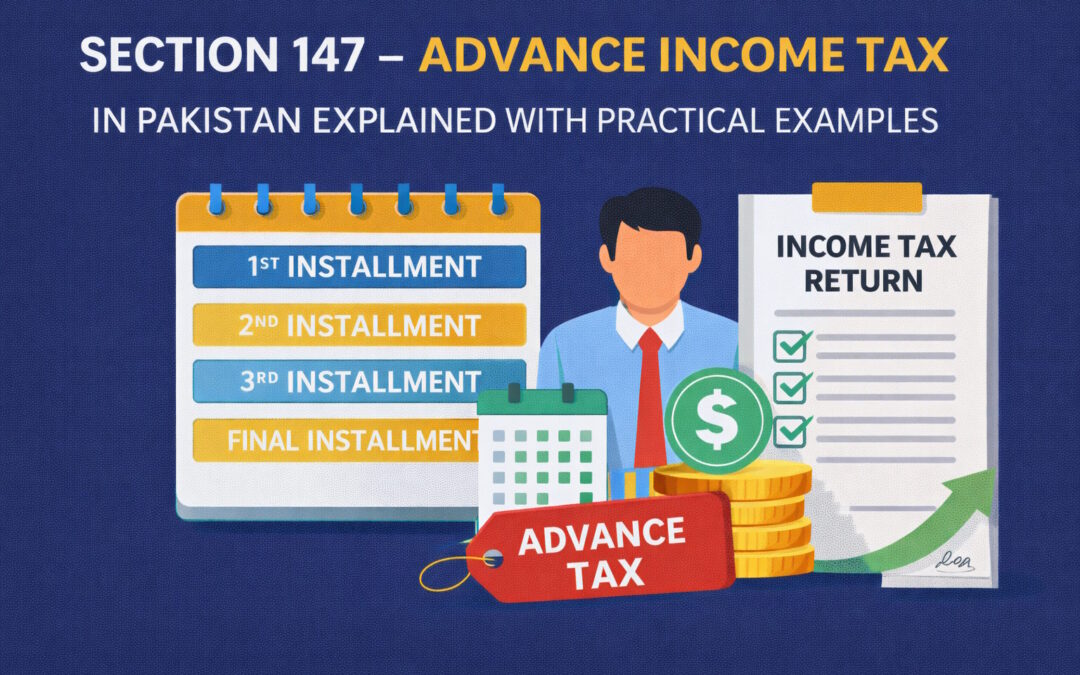
Advance tax is usually paid in quarterly installments, such as:
• First installment
• Second installment
• Third installment
• Final installment
Each installment must be paid within the prescribed due date to avoid penalties.
Adjustment of Advance Tax
Advance tax paid under Section 147 is:
• Fully adjustable
• Credited in the annual income tax return
• Set off against final tax liability
If the advance tax paid exceeds the actual tax liability, the taxpayer may claim a refund.
Revision of Advance Tax Estimate
Taxpayers are allowed to revise their estimated income if actual income is expected to be lower than previous year.
A revised estimate must be:
• Properly calculated
• Filed with FBR
• Supported with reasonable justification
Incorrect estimates may result in penalties.
Advance Tax vs Withholding Tax
Advance Tax (Section 147):
• Paid by the taxpayer himself
• Based on estimated income
Withholding Tax:
• Deducted by another person
• Collected at source
Both taxes are generally adjustable in the annual return.
Consequences of Non-Payment
Failure to pay advance tax may result in:
• Default surcharge
• Penalties
• Increased scrutiny by FBR
Timely payment helps maintain compliance and filer status.
Practical Importance of Section 147
Understanding Section 147 helps taxpayers:
• Manage cash flows
• Avoid year-end tax pressure
• Reduce penalties and interest
• Maintain good tax compliance history
Conclusion
Section 147 ensures that income tax is paid progressively during the year instead of as a lump sum. Proper estimation, timely payment, and correct adjustment in the annual return are essential for smooth tax compliance in Pakistan.
Instructor
Pakistan Practical Taxation Course Post 10 FI
This Practical Taxation Course is prepared by:
Muhammad Taha Farooq
APFA | ITP
Previous Post Pakistan Practical Taxation Course Post 9
Next Post Pakistan Practical Taxation Course Post 11