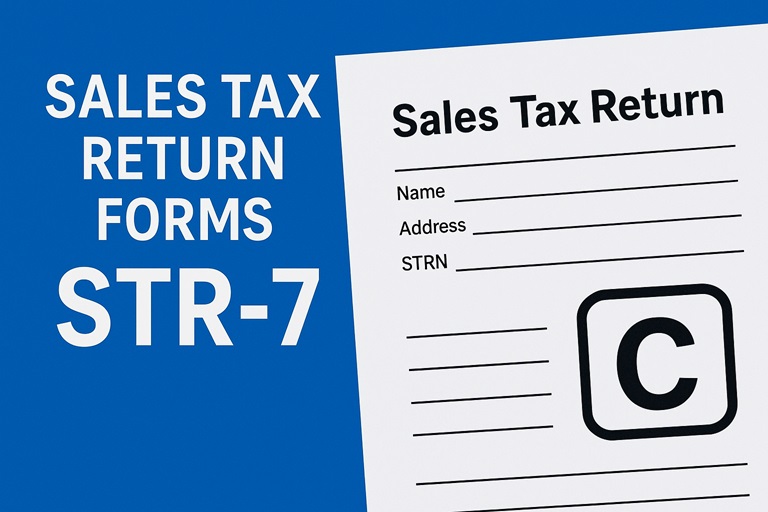
Sales Tax Return Forms STR-7 Pakistan
Day 9: Sales Tax Return Forms (STR-7 & Annexes) in Pakistan
Sales Tax in Pakistan is regulated under the Sales Tax Act, 1990, and businesses registered under sales tax are required to file their returns accurately and within the prescribed due dates. One of the most critical aspects of compliance is understanding and properly filling out the Sales Tax Return Form (STR-7) along with its annexes. Incorrect or incomplete filing may lead to penalties, audits, and unnecessary disputes with tax authorities.
In this detailed guide, we’ll break down the components of STR-7, explain the importance of its annexes (C, F, and H), and discuss why reconciliation with your financial books is crucial for smooth tax compliance.
What is STR-7?
STR-7 is the prescribed monthly sales tax return form in Pakistan. All registered persons under the Sales Tax Act, 1990 are required to file this return electronically through the FBR’s IRIS portal.
The purpose of STR-7 is to report:
- Output tax (sales tax collected on supplies)
- Input tax (sales tax paid on purchases)
- Adjustments, credits, and refunds (if applicable)
- Net payable or refundable tax for the period
This form ensures that the Federal Board of Revenue (FBR) maintains a record of all taxable activities and helps the government in revenue collection.
Structure of STR-7
The STR-7 return consists of a main form and multiple annexes. The annexes capture detailed information about sales, purchases, imports, and withholding transactions, which ultimately reconcile into the main return.
Key Sections of STR-7:
- Basic Information – Registration number, tax period, business activity, etc.
- Output Tax – Details of sales and tax charged.
- Input Tax – Purchases and imports eligible for input tax adjustment.
- Adjustments – Debit/credit notes, advances, or adjustments of prior period tax.
- Net Sales Tax Payable/Refundable – The difference between output and input tax.
Understanding the Annexes of STR-7
Annexes are supporting schedules that must be filled along with the main return. They provide transparency in reporting sales and purchases while ensuring tax credit legitimacy. Among them, Annex C, Annex F, and Annex H play a vital role.
1. Annex C – Purchases and Imports
Annex C requires taxpayers to declare all purchases and imports made during the tax period. It includes:
- Local purchases from registered suppliers
- Imports subject to sales tax
- Tax paid on purchases eligible for input credit
Why is it important?
Annex C is cross-matched with the suppliers’ Annex A (Sales), ensuring transparency in reporting. If a supplier does not declare the sale, the buyer may face issues in claiming input tax credit.
2. Annex F – Sales and Supplies
Annex F captures details of all sales made during the period, including:
- Supplies to registered and unregistered persons
- Zero-rated and exempt supplies
- Exports (if applicable)
Why is it important?
Annex F is directly reconciled with your declared output tax. Any mismatch between Annex F and Annex C (of your buyers) could trigger an audit or show-cause notice.
3. Annex H – Stock Reconciliation
Annex H is a stock statement where the taxpayer declares:
- Opening stock
- Purchases during the period
- Sales during the period
- Closing stock balance
Why is it important?
Annex H ensures that your purchases and sales are backed by proper stock records. This prevents fake invoicing and tax evasion practices. Moreover, mismatched inventory records may lead to heavy penalties.
Importance of Reconciliation with Books
One of the most common mistakes taxpayers make is filing returns without reconciling with their accounting records. This creates discrepancies between financial statements and tax returns, which can raise red flags with the FBR.
Reconciliation is critical because:
- Ensures that sales declared in Annex F match the revenue in financial statements.
- Confirms that input tax claimed in Annex C matches supplier invoices.
- Validates that stock movement in Annex H aligns with actual inventory records.
- Prevents penalties, audits, and delays in refunds.
Businesses should perform a monthly reconciliation exercise before filing STR-7 to identify errors early and make necessary adjustments.
Common Mistakes in Filing STR-7
- Incorrect NTN or STRN of customers/suppliers – This leads to input disallowance.
- Failure to declare exempt or zero-rated supplies separately – Causes reporting errors.
- Mismatched input claims with supplier records – Results in disallowed input tax.
- Omitting credit/debit notes – Leads to over or underpayment of tax.
- Not filing Annex H correctly – May trigger notices for stock discrepancies.
Compliance Benefits of Proper Filing
Filing STR-7 and annexes correctly provides several benefits:
- Avoidance of penalties and litigation.
- Smooth processing of input tax adjustments.
- Improved business credibility with tax authorities.
- Faster refunds in case of excess input tax.
- Reduced chances of being flagged for audit.
Marketing Section – Why Choose MTF & Co. @ One Web One Hub for Sales Tax Compliance?
Sales tax compliance in Pakistan is increasingly becoming complex and digitalized. Even a small mistake in STR-7 or its annexes can cost your business penalties, blocked refunds, or unwanted audits.
This is where MTF & Co. @ One Web One Hub comes in.
Our team of experienced accountants and tax consultants specializes in:
- Accurate filing of STR-7 and annexes.
- Monthly reconciliation of sales, purchases, and stock records.
- Handling sales tax audits and notices from FBR.
- Ensuring maximum input tax credit recovery.
- Providing real-time bookkeeping and compliance solutions tailored to your industry.
By outsourcing your bookkeeping and tax compliance to us, you save time, avoid errors, and focus on growing your business while we handle the paperwork.
📌 Book a free consultation today with MTF & Co. @ One Web One Hub and never worry about sales tax returns again!
Conclusion
Day 9 Post FI
Understanding and correctly filing STR-7 and its annexes is a vital part of sales tax compliance in Pakistan. Annex C (Purchases), Annex F (Sales), and Annex H (Stock) provide transparency and accountability in reporting. However, these must always be reconciled with your accounting books to avoid mismatches, penalties, and disputes.
With professional support from MTF & Co. @ One Web One Hub, you can simplify the process and ensure your business stays compliant with all legal requirements.
Previous Post Sales tax filing due dates Pakistan
Next Post Generating PSID for Sales Tax Payment in Pakistan