Sales Tax Rates in Pakistan
Day 5: Sales Tax Rates in Pakistan
Standard Sales Tax Rate, Reduced Rates, Zero-Rated Supplies, and Exempt Goods & Services
Sales tax is one of the most significant sources of revenue for the Government of Pakistan. It plays a vital role in bridging the fiscal gap, funding public projects, and ensuring equitable taxation across industries. For businesses, understanding sales tax rates in Pakistan is crucial to remain compliant with the Federal Board of Revenue (FBR) and the Provincial Revenue Authorities (PRA, SRB, KPRA, and BRA).
In this post, we will cover:
- The standard sales tax rate in Pakistan.
- Reduced rates and how they apply to specific goods and services.
- Zero-rated supplies and their importance for exporters.
- Exempt goods and services and what this means for businesses.
By the end, you will have a clear understanding of how to apply the correct rates and avoid costly penalties during sales tax filing.
Standard Sales Tax Rate in Pakistan
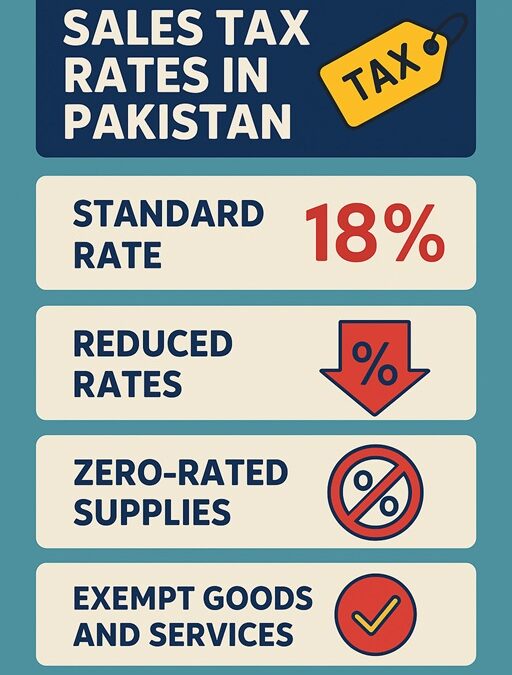
The standard rate of sales tax in Pakistan is 18%, applicable to most taxable goods and services. This rate is charged on the value of supplies at every stage of the supply chain — from manufacturer to wholesaler, distributor, and retailer — with input tax adjustments available to prevent double taxation.
For instance:
- A manufacturer selling textiles to a wholesaler must charge 18% sales tax.
- The wholesaler can claim input tax credit for the sales tax already paid on purchase.
- The retailer finally charges 18% to the consumer, remitting the tax to FBR.
Important Note
The 18% rate applies to both goods and services at the federal level, unless provincial authorities specify otherwise for services within their jurisdiction.
Reduced Sales Tax Rates
Pakistan applies reduced rates of sales tax on specific goods and services to provide relief to consumers and support priority sectors.
Examples include:
- Essential goods: Some food items and medicines may attract a lower rate.
- Petroleum products: Tax rates may vary depending on government policy.
- Telecommunications: Subject to varying rates at federal and provincial levels.
Reduced rates are often introduced through the annual Finance Act, so businesses must stay updated to apply the correct rate. Misapplication can lead to underpayment or overpayment of sales tax, both of which can create compliance issues.
Zero-Rated Supplies
Zero-rating is a special category under the sales tax regime. Zero-rated goods and services are taxed at 0%, but input tax credits are still available. This helps exporters remain competitive in international markets.
Common Zero-Rated Supplies in Pakistan:
- Exported goods.
- Supplies made to diplomats and privileged organizations.
- Supplies to registered exporters in certain industries like textiles, leather, carpets, and surgical instruments.
The key benefit of zero-rating is that exporters can claim refunds on input tax paid locally, ensuring that their exports remain tax-free at the international level.
Exempt Goods and Services
Exemption is different from zero-rating. Exempt goods and services are not subject to sales tax at all, and no input tax credits are allowed.
Examples of Exempt Goods & Services:
- Basic food items (wheat, rice, pulses, vegetables).
- Educational and health services.
- Books, newspapers, and certain educational supplies.
Businesses dealing exclusively in exempt goods or services are generally not required to register for sales tax, since no tax is charged or collected.
Federal vs. Provincial Application of Sales Tax Rates
While FBR administers sales tax on goods, provinces collect sales tax on services through their respective authorities:
- Punjab Revenue Authority (PRA) – Punjab.
- Sindh Revenue Board (SRB) – Sindh.
- Khyber Pakhtunkhwa Revenue Authority (KPRA) – KPK.
- Balochistan Revenue Authority (BRA) – Balochistan.
Each province may set different rates for services, ranging between 13% and 16%, depending on the type of service.
For example:
- IT services in Punjab may be charged at 16%.
- Hospitality and restaurant services in Sindh may attract 13%.
Businesses operating across multiple provinces must ensure they apply the correct provincial rates and file returns accordingly.
Practical Example: Sales Tax Rates Applied
Suppose a company operates in Karachi (Sindh) and provides software development services while also selling hardware.
- Hardware sales (goods): 18% sales tax under FBR.
- Software services (services): 13% under SRB.
This company must file two different returns: one with FBR and another with SRB, applying the correct rates in each case.
Common Mistakes Businesses Make
- Applying wrong rates — Using federal rates for services that are provincial.
- Missing updates in Finance Act — Sales tax rates can change annually.
- Confusing zero-rated with exempt supplies — Exporters losing input tax refunds due to incorrect classification.
- Not filing in multiple jurisdictions — Businesses with operations in more than one province must file separately.
Avoiding these mistakes is critical to ensure compliance and avoid penalties.
Best Practices for Businesses
Day 5 Post
- Always check the latest FBR and provincial notifications before applying rates.
- Maintain proper invoices and records to support your sales tax calculations.
- Hire a professional tax consultant if operating across multiple jurisdictions.
- Use accounting software like QuickBooks or ERP systems to automate tax calculations and reduce errors.
Marketing Section
At MTF&Co. @ One Web One Hub, we provide end-to-end bookkeeping, tax consultancy, and compliance services for businesses in Pakistan and abroad.
Our services include:
- Sales Tax Registration and Filing with FBR and provincial authorities.
- Income Tax Return Preparation and Submission.
- Monthly bookkeeping and financial reporting.
- Tax advisory for exporters, IT companies, and service providers.
- Refund claims and audit handling.
Whether you are a startup, SME, or an established business, outsourcing your tax and accounting needs to professionals saves time, reduces risk, and ensures compliance.
📞 Contact MTF&Co. @ One Web One Hub today to discuss how we can simplify your bookkeeping and tax compliance.
Previous Post Provincial Sales Tax on Services in Pakistan
Next Post Sales Tax Invoicing Requirements in Pakistan