FARTCOINUSDT – Probability Analysis for December 19, 2025
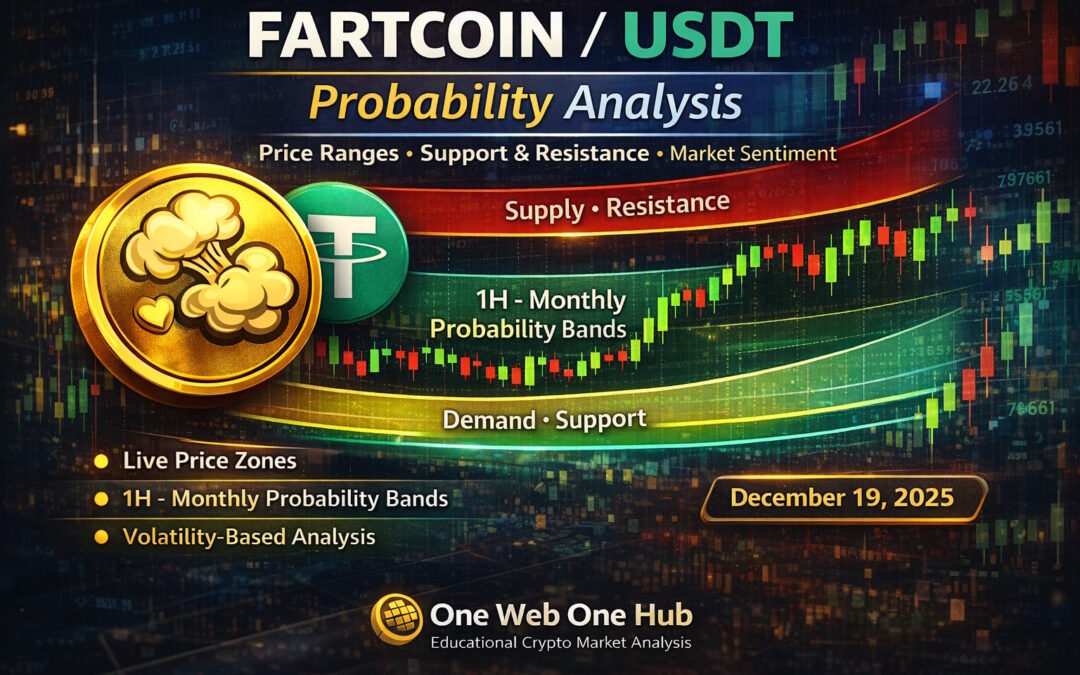
FARTCOIN/USDT Price Probability Analysis
December 19, 2025
This probability-based analysis for FARTCOIN/USDT uses live market price data to estimate likely price ranges across multiple timeframes. Numbers, formulas, and logic are transparent so readers can reproduce every result on their own.
At the time of writing, FARTCOIN is trading near its 24-hour lower range on major exchanges, with active volume and mixed directional sentiment.
Live Price Snapshot
Current aggregated live mid-price (CoinGecko data): ≈ 0.288 USDT.
24-hour observed range: High ≈ 0.3559 USDT, Low ≈ 0.2880 USDT. (CoinGecko)
These values form the basis of the volatility and probability bands below.
Use baseline P₀ = 0.288 USDT for all range calculations.
Methodology
This analysis uses a simple range-to-volatility → scaled probability model:
- Measure the real observed 24h range (H-L) relative to the midpoint.
- Convert that range into a daily volatility estimate: assume full daily range ≈ 4 × σdaily.
- Scale volatility for other horizons using the square-root-of-time.
- Use the normal log-return model to estimate the two-sided probability of price staying within ±X.
- Translate probabilities into price bands around the baseline.
This model is transparent but simple and underestimates extreme tail risk. It should be used to frame structured risk, not predict exact outcomes.
Volatility Calculation Using Live Data
24-hour full range = 0.3559 − 0.2880 = 0.0679 USDT.
Midpoint = (0.3559 + 0.2880) / 2 = 0.32195 USDT.
Relative 24h range = 0.0679 / 0.32195 ≈ 21.10%.
Assuming full range ≈ 4 × daily volatility:
σdaily ≈ 21.10% / 4 ≈ 5.28% per day.
Scale to other horizons:
• σ1H ≈ 5.28% / √24 ≈ 1.08%.
• σ4H ≈ 5.28% / √6 ≈ 2.16%.
• σweek ≈ 5.28% × √7 ≈ 13.97%.
• σmonth ≈ 5.28% × √30 ≈ 28.87%.
These values reflect elevated volatility relative to stable market conditions.
1-Hour Price Probability Bands
Using σ1H ≈ 1.08% and baseline P₀ = 0.288 USDT:
±0.5% → Probability ≈ 33%
Price band: 0.2866 — 0.2894 USDT
±1.0% → Probability ≈ 58%
Price band: 0.2851 — 0.2909 USDT
±2.0% → Probability ≈ 86%
Price band: 0.2822 — 0.2938 USDT
Interpretation: In the short term, small moves are less likely than on quieter days; expect wider 1-hour swings.
4-Hour Price Probability Bands
Using σ4H ≈ 2.16%:
±1.0% → Probability ≈ 58%
Price band: 0.2851 — 0.2909 USDT
±2.0% → Probability ≈ 86%
Price band: 0.2822 — 0.2938 USDT
±4.0% → Probability ≈ ≈99% (model)
Price band: 0.2765 — 0.2995 USDT
This suggests 4-hour swings up to ±4% are statistically normal under current volatility.
Daily Price Probability Bands
Using σdaily ≈ 5.28%:
±5.0% → Probability ≈ 58%
Price band: 0.2736 — 0.3024 USDT
±8.0% → Probability ≈ 84%
Price band: 0.2649 — 0.3111 USDT
±12.0% → Probability ≈ ≈97% (model)
Price band: 0.2534 — 0.3226 USDT
Daily probabilities show moderate tails, suggesting multiple scenarios remain plausible.
Weekly Price Probability Bands
Using σweek ≈ 13.97%:
±10% → Probability ≈ 58%
Price band: 0.2592 — 0.3168 USDT
±20% → Probability ≈ 84%
Price band: 0.2304 — 0.3456 USDT
±30% → Probability ≈ ≈97% (model)
Price band: 0.2016 — 0.3744 USDT
Weekly bands capture broader structural uncertainty.
Monthly Price Probability Bands
Using σmonth ≈ 28.87%:
±25% → Probability ≈ ≈52%
Price band: 0.2160 — 0.3600 USDT
±40% → Probability ≈ 84%
Price band: 0.1728 — 0.4032 USDT
±60% → Probability ≈ ≈95% (model)
Price band: 0.1152 — 0.4608 USDT
Monthly horizons show significant tail risk — use for sizing long-term positions.
Demand & Supply Zones
These zones are derived from recent clustering of price reactions:
Demand zones (buyer interest):
• 0.270 — 0.285 USDT — near-term demand cluster.
• 0.240 — 0.265 USDT — deeper daily accumulation region.
• 0.200 — 0.225 USDT — structural support on broader drawdowns.
Supply zones (seller pressure):
• 0.310 — 0.330 USDT — near-term supply.
• 0.345 — 0.365 USDT — daily rejection region.
• 0.380 — 0.420 USDT — higher timeframe supply.
Key Support & Resistance Levels
Support levels:
• 0.285 USDT — intraday structural support.
• 0.265 USDT — daily support cluster.
• 0.240 USDT — deeper support.
Resistance levels:
• 0.310 USDT — near-term resistance.
• 0.330 USDT — daily resistance.
• 0.360 USDT — higher timeframe resistance.
These act as decision points for entries, exits, and stops.
Market Sentiment Snapshot
Market sentiment currently leans neutral to slightly bearish. Recent range activity shows:
• Price near the lower 24h band with active volume.
• Mixed technical readings on shorter timeframes; sentiment is cautious.
• Fear & greed metrics and community sentiment suggest traders are risk-aware but not capitulating.
This mixed picture means range trading with disciplined risk control may be more successful than breakout chasing.
Practical Trading Notes
• Confirm live prices and depth on your execution venue (prices vary slightly across Bitget, Coinbase, KuCoin).
• The normal return model used here underestimates tail risk — crypto can deviate sharply beyond model bands.
• Volatility spikes can quickly widen realized ranges; always adjust risk accordingly.
• Use limit orders where possible in thinner books.
Educational Disclaimer
This content is provided for educational purposes only. It is not financial, trading, investment, or tax advice. Probability bands are model outputs based on explicit assumptions. Cryptocurrencies are highly volatile and can move beyond statistical expectations. Always do your own research and apply prudent risk management.
Basis of Probability Calculations
Inputs:
Baseline price P₀ = 0.288 USDT.
24h high H = 0.3559 USDT.
24h low L = 0.2880 USDT.
- Full observed range: H − L = 0.0679.
- Midpoint = (H + L)/2 = 0.32195.
- Relative full range = 0.0679/0.32195 ≈ 21.10%.
- Daily σ ≈ 21.10% / 4 = 5.28%.
- Volatility scaling: σₜ = σdaily × √(t in days).
- Probability = erf(X / (σₜ × √2)).
- Price bands = P₀ × (1 ± X).
Every band in this post uses these steps.
Follow & Subscribe To One Web One Hub — Trade With Structure, Not Guesswork

2025 Dec 19 FARTCOINUSDT FI
At One Web One Hub, we publish daily probability briefs that help you:
• Understand risk across multiple horizons.
• Identify valid demand/supply zones and support/resistance levels.
• Compare how probabilities evolve.
• Build disciplined strategies instead of guesswork.
Bookmark this post, compare it with yesterday’s and tomorrow’s analysis, and subscribe to daily updates.
Trade with structure. Not guesswork.
Previous Post FARTCOINUSDT – Probability Analysis for December 18, 2025
Next Post FARTCOINUSDT – Probability Analysis for December 20, 2025