Pakistan Practical Taxation Course Post 20
Post 20 – Treatment of Provision for Bad & Doubtful Debts under Pakistan Income Tax Law
Introduction
In practical accounting, businesses often create provisions for bad and doubtful debts to reflect expected credit losses. However, for tax purposes in Pakistan, the treatment of such provisions is strictly regulated. Many taxpayers mistakenly claim these provisions as deductible expenses, leading to disallowances during audit or assessment.
In this post, we explain the correct tax treatment of provision for bad and doubtful debts under the Income Tax Ordinance, 2001, with clear guidance for compliance and tax planning.
What Is a Provision for Bad & Doubtful Debts?
A provision for bad and doubtful debts is an estimated expense recorded in the accounts to cover receivables that may not be recovered. It is based on judgment, aging analysis, or expected credit loss models.
From an accounting perspective, it follows prudence.
From a tax perspective, estimation alone is not enough.
General Rule under Pakistan Tax Law
Under the Income Tax Ordinance, 2001, provisions are not automatically allowable as deductions.
Key Principle
Only actual, realized, and incurred expenses are deductible for tax purposes unless specifically allowed by law.
A provision for bad and doubtful debts is considered an anticipated loss, not an actual loss.
Relevant Legal Provisions
Section 21 – Deductions Not Allowed
Section 21(l) specifically disallows any provision made for anticipated losses unless expressly permitted.
This means that a mere accounting provision for doubtful debts is not tax deductible.
When Bad Debts Are Allowed as Deduction
Actual bad debts can be claimed as a deduction when all of the following conditions are met:
- The amount was previously included in taxable income
- The debt has become irrecoverable during the tax year
- The debt is written off in the books of accounts
- Proper evidence of recovery efforts is available
Once these conditions are fulfilled, the amount qualifies as an allowable deduction under normal business expense rules.
Provision vs Actual Write-Off (Important Distinction)
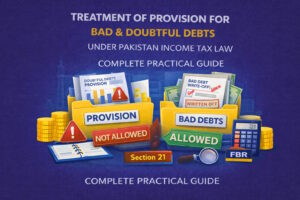
Provision for doubtful debts
Estimated amount, Not written off, Not allowable for tax
Bad debt written off
Confirmed irrecoverable amount, Removed from receivables, Allowable for tax (subject to conditions)
This distinction is a common point raised during Section 177 audits.
Banking Companies and NBFCs (Special Case)
Banks and certain financial institutions may be allowed deductions for provisions under specific rules issued by SBP or SECP, subject to prescribed limits and conditions.
For non-banking businesses, no such general relaxation exists.
Impact During Tax Audit (Section 177)
During audit proceedings, FBR commonly:
- Adds back provision for doubtful debts to taxable income
- Demands reconciliation between accounting profit and tax profit
- Requires evidence of actual write-off
- Failure to justify the claim may result in additional tax, default surcharge, and penalties.
Practical Tax Planning Tips
- Do not claim provisions as tax deductions
- Maintain proper aging and recovery documentation
- Write off debts only when recovery is genuinely impossible
- Ensure written-off debts were previously taxed
- Maintain board or management approval for write-offs
These practices reduce audit exposure and strengthen your tax position.
Common Mistakes to Avoid
- Claiming provision instead of actual write-off
- Failing to reverse provision in tax computation
- Not maintaining recovery correspondence
- Writing off personal or related party receivables without justification
Conclusion
Pakistan Practical Taxation Course Post 20 FI
While provisions for bad and doubtful debts are acceptable for accounting purposes, they are not allowable for tax deduction in Pakistan unless converted into actual bad debts through proper write-off. Understanding this distinction is critical for accurate tax computation and avoiding disputes with FBR.
In the next post, we will discuss another important compliance and audit-related topic to further strengthen your understanding of Pakistan’s income tax framework.
Previous Post Pakistan Practical Taxation Course Post 19
Next Post Pakistan Practical Taxation Course Post 21