FARTCOINUSDT – Probability Analysis for December 04, 2025
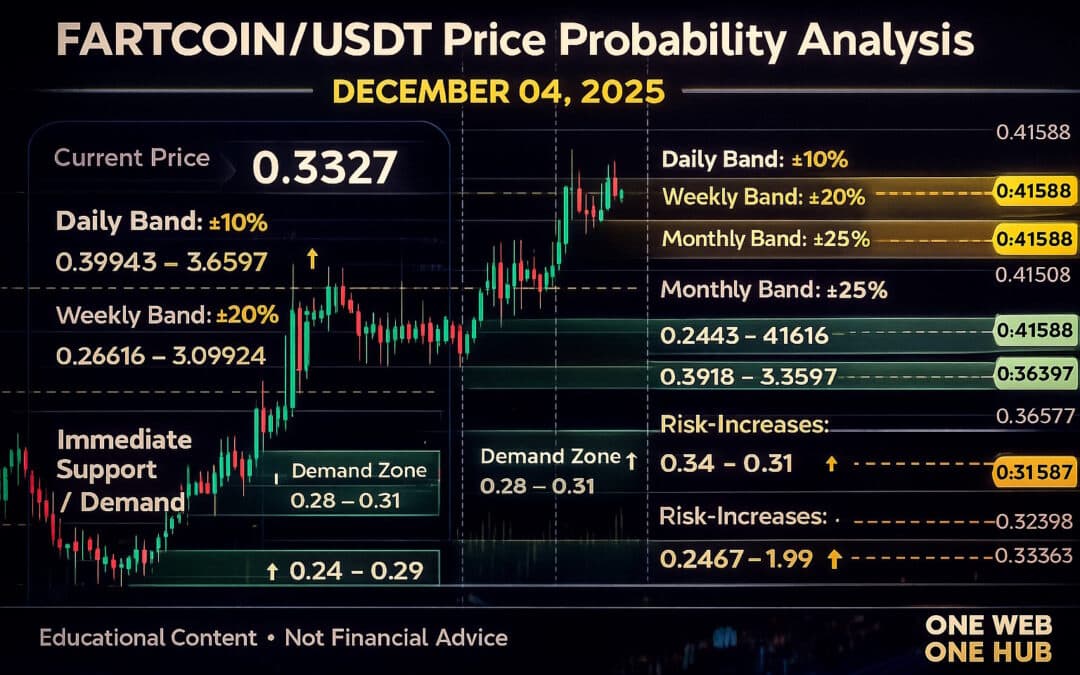
FARTCOIN/USDT Price Probability Analysis — December 04, 2025
Below is a ready-to-publish WordPress-friendly post with H2 / H3 headings.
All range math is shown step-by-step and uses TradingView/Binance live data. This is educational content — see the disclaimer near the end.
Current market snapshot (TradingView baseline + venue context)
TradingView’s market listings show FARTCOIN/USDT trading in the low-mid $0.30 range (aggregated market listings show prices around 0.33 USDT on major venues). (TradingView)
Binance futures/spot stats show a 24-hour high of 0.3949 USDT and a 24-hour low of 0.3063 USDT (these extremes are used to estimate short-term realized range/volatility). (Binance)
CoinMarketCap and CoinGecko display similar mid-$0.30 prints with strong 24-hour volumes confirming active cross-exchange trading (useful when judging liquidity). (CoinMarketCap)
Basis of the probability model
We use a transparent, simple volatility → probability workflow so readers can reproduce the numbers.
Reference/baseline price used
TradingView mid / aggregated listing baseline ≈ 0.3327 USDT. (TradingView)
Volatility estimate from 24h high/low
- 24-hour high − 24-hour low = 0.3949 − 0.3063 = 0.08860 USDT. (Binance)
- Midpoint of high & low = (0.3949 + 0.3063) / 2 = 0.35060 USDT.
- Relative 24h range = 0.08860 / 0.35060 = 0.25271 → 25.27%.
- Convert range → daily standard deviation (σdaily) using the rule-of-thumb range ≈ 4 × σ:
σdaily ≈ 0.25271 / 4 = 0.06318 → 6.32% daily volatility.
(This heuristic is widely used for quick, transparent volatility estimates; you can substitute realized volatility from intraday returns if preferred.)
Scaling for longer horizons
• σweek = σdaily × √7 ≈ 6.3177% × √7 ≈ 16.72%.
• σmonth = σdaily × √30 ≈ 6.3177% × √30 ≈ 34.60%.
Statistical model
We assume (for this simple model) log-returns are approximately normally distributed with mean 0 and standard deviation = σ for the chosen horizon. That allows computing the probability that returns remain within ±X% bands using the Normal CDF. These are illustrative probabilities under the model’s assumptions — not guarantees.
Probability-based price ranges
Below are the model outputs (probabilities and the corresponding price bands). All price bands are simply baseline × (1 ± band).
Daily — next 24 hours
• ±5% band
• Model probability ≈ 57.13% that price stays inside ±5%.
• Price band ≈ 0.31607 — 0.34934 USDT.
• ±8% band
• Model probability ≈ 79.46% that price stays inside ±8%.
• Price band ≈ 0.30609 — 0.35932 USDT.
• ±10% band
• Model probability ≈ 88.65% that price stays inside ±10%.
• Price band ≈ 0.29943 — 0.36597 USDT.
(Interpretation: under the 6.32% daily σ estimate, there’s roughly an ~79% chance FARTCOIN remains within ±8% of 0.3327 over the next 24 hours.)
Weekly — next 7 days
• ±10% band
• Probability ≈ 45.03% that price stays inside ±10%.
• Price band ≈ 0.29943 — 0.36597 USDT.
• ±20% band
• Probability ≈ 76.85% that price stays inside ±20%.
• Price band ≈ 0.26616 — 0.39924 USDT.
Monthly — next 30 days
• ±25% band
• Probability ≈ 53.00% that price stays inside ±25%.
• Price band ≈ 0.24953 — 0.41588 USDT.
• ±50% band
• Probability ≈ 85.15% that price stays inside ±50%.
• Price band ≈ 0.16635 — 0.49905 USDT.
Important: if realized volatility increases or drops, these probabilities change quickly — the model is conditional on the σ estimates above.
Sources for price & range inputs: TradingView aggregated listings and Binance 24h high/low. (TradingView)
Key technical zones — support, resistance, demand & supply
These zones are gathered from recent clustering and visible price behaviour (TradingView / Binance charts). Always confirm levels on the exchange you will trade.
Immediate resistance/supply zones
• 0.34 — 0.36 USDT — visible upper rejection cluster in recent sessions (near the daily upper bands). (TradingView)
• 0.45 — 0.60 USDT — broader profit-taking band if a strong breakout occurs (liquidity may thin here).
Immediate support/demand zones
• 0.29 — 0.31 USDT — near-term support area where buyers re-entered on dips. (CoinGecko)
• 0.24 — 0.26 USDT — deeper structural support if selling accelerates.
Demand zone to watch (accumulation)
• 0.28 — 0.31 USDT — watch for volume confirmation before assuming a durable base.
Supply zone to watch (profit taking)
• 0.34 — 0.38 USDT — likely profit-taking area; repeated rejections show this zone carries selling pressure.
Liquidity note: exchanges and perpetual/spot feeds vary in price and depth — Binance, Bitget and other venues show different exact prints and order-book depths; always check the venue you will trade. (Bitget)
Sentiment analysis
- Social media snapshot (X / CoinMarketCap social panel): recent social posts show a mix of bullish and neutral sentiment with pockets of bullish activity (roughly ~30–40% bullish mentions on X in recent sample windows). CoinMarketCap’s social metrics indicate active discussion but mixed tone. (Coinbase)
- Aggregate sentiment & volume context: CoinGecko / CoinMarketCap show rising 24-hour volumes alongside price strength — this indicates buying interest but can also be short-term momentum (fader) rather than sustainable accumulation. (CoinGecko)
- Technical-sentiment combination: price action near resistance with elevated volume suggests traders are rotating positions; look for divergence between on-chain indicators (whale transfers, exchange inflows) and social euphoria to judge sustainability. (If exchange inflows spike, that’s a bearish signal; sustained outflows/accumulation on non-exchange wallets is more bullish.)
Practical read: social sentiment is mixed-to-slightly bullish at the moment but not overwhelmingly euphoric. Combine social signals with order-book and on-chain checks for better conviction. (Coinbase)
Trading & risk notes
• Use the model’s ranges only as planning guides — not trade entries by themselves.
• For intraday work, prefer limit entries and check order-book depth; large market orders into thin books cause slippage. (Bitget)
• For swing trades, confirm accumulation in the demand zone with rising buy volume and falling sell pressure.
• Always size positions to a risk you can tolerate and use stop losses.
Model limitations & risk warnings
This analysis uses a simplified normal-returns model and a rule-of-thumb conversion from 24-hour range to daily σ. Crypto returns commonly show volatility clustering and heavy tails: sudden, large moves happen more frequently than a simple normal model implies. Use these outputs as a disciplined planning tool, not a certainty.
Disclaimer (VERY IMPORTANT)
This post is educational only. It is not financial, investment, trading, or tax advice. The probability ranges are model outputs based on explicit assumptions (see “Basis of the probability model”). Past performance does not guarantee future results. Always perform your own research and use proper risk management.
Engage with One Web One Hub
2025 Dec 04 FARTCOINUSDT FI With Referral Link
If you like transparent, assumption-driven crypto analysis (not opaque price “predictions”), One Web One Hub publishes daily probability briefs and practical trade-aware guides:
• Daily probability-based token briefs you can reproduce on your exchange.
• Weekly deep dives combining on-chain signals, funding/open interest checks and volatility models.
• Downloadable calculators and cheat-sheets so you can run the same model on any token in under a minute.
Visit One Web One Hub, request the tokens you trade, and join a community that values clarity, reproducibility, and practical trading discipline.
Sources
TradingView markets & symbol listings; Binance 24h high/low / futures; CoinMarketCap; CoinGecko; exchange order-book snapshots (Binance / Bitget). (TradingView)