CP 575 Course Day 15 Post
Day 15: Comparing Form 1065 vs Form 1120 vs Form 1120-S – Advantages & Pitfalls
Correctly choosing between Form 1065, Form 1120, and Form 1120-S is one of the most important tax decisions an LLC owner will ever make. Each filing option leads to different tax outcomes, administrative duties, and IRS compliance requirements. Day 15 helps you compare all three so you can understand which structure best fits your business.
Introduction
By Day 15, you have learned how the IRS views LLCs and how Notice CP 575 helps confirm your tax classification. Now it is time to compare your three main federal tax filing paths:
Form 1065 – Default for Multi-Member LLCs
Form 1120 – When LLC elects C Corporation taxation
Form 1120-S – When LLC elects S Corporation taxation
Below is a clear comparison of each option, along with advantages, disadvantages, and common mistakes business owners make.
Form 1065 – Partnership Return(Default for Multi-Member LLCs)
Who files it
Two or more members in an LLC filing under default IRS rules.
Tax treatment
Pass-through taxation. The business itself pays no federal income tax. Profits and losses pass to members using Schedule K-1.
Advantages
• No double taxation
• Easy to maintain and operate
• Losses can often offset members’ other income
• Flexible profit-sharing arrangements
Pitfalls
• Members must pay self-employment tax on their share of income
• Complex K-1 reporting for each member
• Partners cannot be employees of the LLC
• More scrutiny if profit-sharing ratios are irregular
Best for LLCs that want pass-through taxation and flexible profit distribution.
Form 1120 – C Corporation Taxation (LLC elects C-Corp using Form 8832)
Who files it
LLCs choosing to be taxed as C Corporations.
Tax treatment
The corporation pays its own tax at 21% federal corporate tax rate. Owners pay additional tax on dividends (double taxation).
Advantages
• Flat 21% corporate tax rate may be lower than individual rates
• Owners can be W-2 employees
• No self-employment tax on distributions
• Easier to raise investment and retain earnings
Pitfalls
• Double taxation if profits are distributed
• More rigid compliance rules
• Annual minutes and corporate formalities expected
• IRS closely monitors “reasonable compensation.”
Best for LLCs that want employment status, reinvest profits, or need a corporate structure for growth.
Form 1120-S – S Corporation Taxation(LLC elects S-Corp using Form 2553)
Who files it
LLCs electing S Corporation status with eligible shareholders.
Tax treatment
Pass-through taxation but with special rules allowing members to reduce self-employment taxes.
Advantages
• Reduces self-employment tax through salary + distribution split
• Still avoids corporate double taxation
• Owners can be W-2 employees
• Good balance between tax savings and compliance
Pitfalls
• IRS requires a “reasonable salary” for owners
• Strict shareholder restrictions (100 max, must be U.S. persons)
• Only one class of stock allowed
• Higher bookkeeping and payroll costs
Best for LLCs that generate stable profit and want to minimize self-employment taxes.
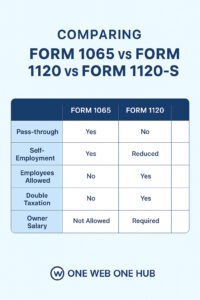
Side-by-Side Comparison Table
Tax Form Comparison
Form 1065
• Pass-through: Yes
• Self-Employment Tax: Yes
• Employees Allowed: No
• Double Taxation: No
• Owner Salary: Not Allowed
Form 1120
• Pass-through: No
• Self-Employment Tax: No
• Employees Allowed: Yes
• Double Taxation: Yes
• Owner Salary: Required if working
Form 1120-S
• Pass-through: Yes
• Self-Employment Tax: Reduced
• Employees Allowed: Yes
• Double Taxation: No
• Owner Salary: Required
Which Option Should an LLC Choose?
Choose Form 1065 if
Your LLC has multiple members and wants simple pass-through taxation.
Choose Form 1120 if
You want to reinvest profits or benefit from the 21% flat corporate rate.
Choose Form 1120-S if
You want to save on self-employment taxes and qualify for S-Corp rules.
Final Thoughts
Day 15 Post FI
Form 1065, Form 1120, and Form 1120-S each create very different tax outcomes. The correct choice depends on:
• Number of members
• Profit levels
• Growth plans
• Eligibility rules
• IRS expectations shown in Notice CP 575
Understanding these forms ensures that your LLC remains compliant and tax-efficient year after year.
Your Day 15 lesson is now complete. Tomorrow, we begin Module 4: Applying Notice CP 575 to Real-World Filing Scenarios.
Previous Post CP 575 Course Day 14 Post
Next Post CP 575 Course Day 16 Post